
One of the stranger things about astrology is that it is usually marketed to people who have not yet lived long enough to see how it will truly unfold in their lives.
Astrology apps, personality charts, compatibility analyses — the entire shabang seems designed for people just beginning in life. The language is often presented as a kind of cosmic personality quiz: What sign are you? Who are you compatible with? Why does Mercury retrograde ruin everyone’s week?
This gives the impression that astrology is primarily concerned with explaining who we are — or at least why our ex behaved so strangely.
But the more I learn about astrology, the less convincing that explanation becomes.
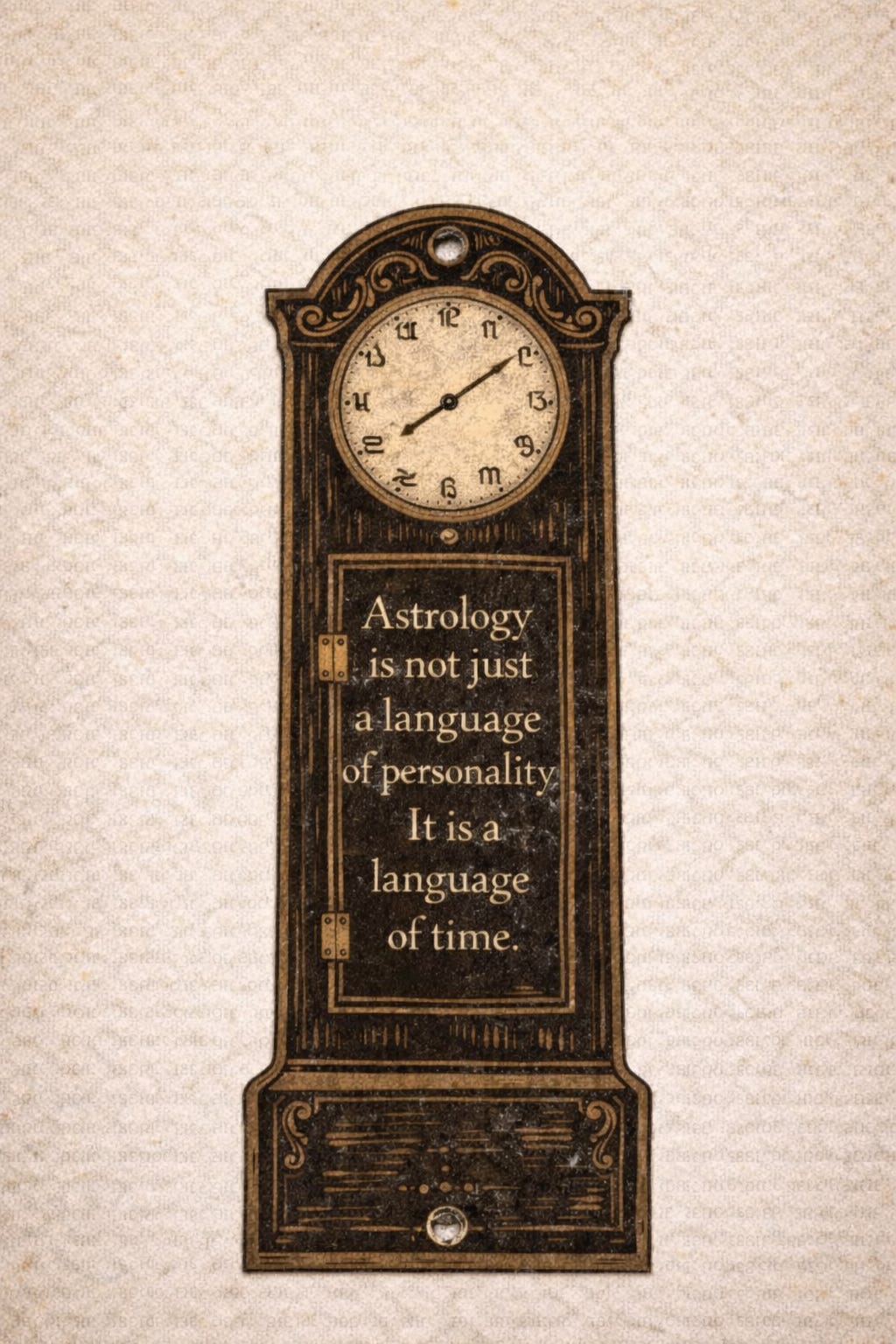
Astrology is not really a language of personality.
It is a language of time.
Personality is on display in a chart, but astrology is far more interested in cycles — the rhythms through which events, challenges, and opportunities unfold across a lifetime.
The sky moves in repeating patterns, and astrology attempts to describe the relationship between those patterns and the development of a human life.
When you first encounter astrology, this idea can feel abstract.
Planetary cycles sound interesting enough in theory, but without experience, they remain just that — theory. A twenty-year-old can read about Saturn cycles or Jupiter returns, but they may not have lived long enough to see any patterns yet.
You see, time has a way of clarifying things.
After a few decades, life begins to behave less like a series of isolated incidents and more like a set of recurring seasons.
Periods of expansion appear.
Periods of contraction follow.
Certain kinds of challenges arrive with suspicious regularity.
Careers rise and fall. Relationships appear and disappear. Entire phases of life repeat themselves with the persistence of a seasonal allergy.
What once looked like randomness begins to resemble structure.
Astrology describes life in exactly this way — not as a straight line, but as a series of cycles unfolding over time.
The planets move in predictable rhythms, and those rhythms seem to echo through our lives in curious ways.
The longer we live, the easier it becomes to notice this.
Experiences that once felt confusing begin to take on a different shape in retrospect.
A difficult period reveals itself as a turning point.
A disruption turns out to have been a necessary correction.
What once felt like chaos begins to resemble timing.
Astrology does not necessarily make life predictable.
But it can make life recognizable.
Which, as it turns out, can be quite as useful.
Patterns that once felt mysterious begin to look familiar. Certain phases of life become easier to identify as they unfold.
The sky, which once seemed distant, starts to feel more like a clock quietly marking the passage of seasons.
The longer we live, the less mysterious astrology becomes — not because the sky changes, but because we finally have enough history to recognize the patterns.
In my last post, I wrote about bonification — the strange way time sometimes improves the meaning of things.
Astrology, in its own way, describes the same phenomenon.
It does not tell you what will happen.
It helps you recognize when something is happening.
At a certain point, astrology begins to resemble a kind of weather report.
Not a prediction of what must happen,
but a way of understanding the season you’re in.